Biomass Pellet Plant Setup in India: Complete Guide
Every winter farmers across north India burn straw in their fields because nobody pays them enough to carry it away. That same straw now has a steady industrial buyer. Coal power stations must blend biomass pellets with coal, and NTPC alone floated tenders for lakhs of tonnes of pellets in 2026. This guide explains biomass pellet plant setup in India step by step, from finding a buyer and choosing capacity to machinery, approvals, subsidy, finance and quality. We have written it from the shop floor of TRIO Renewable Engineering in Jaipur, where our team builds and installs pellet plant machinery for clients across India.
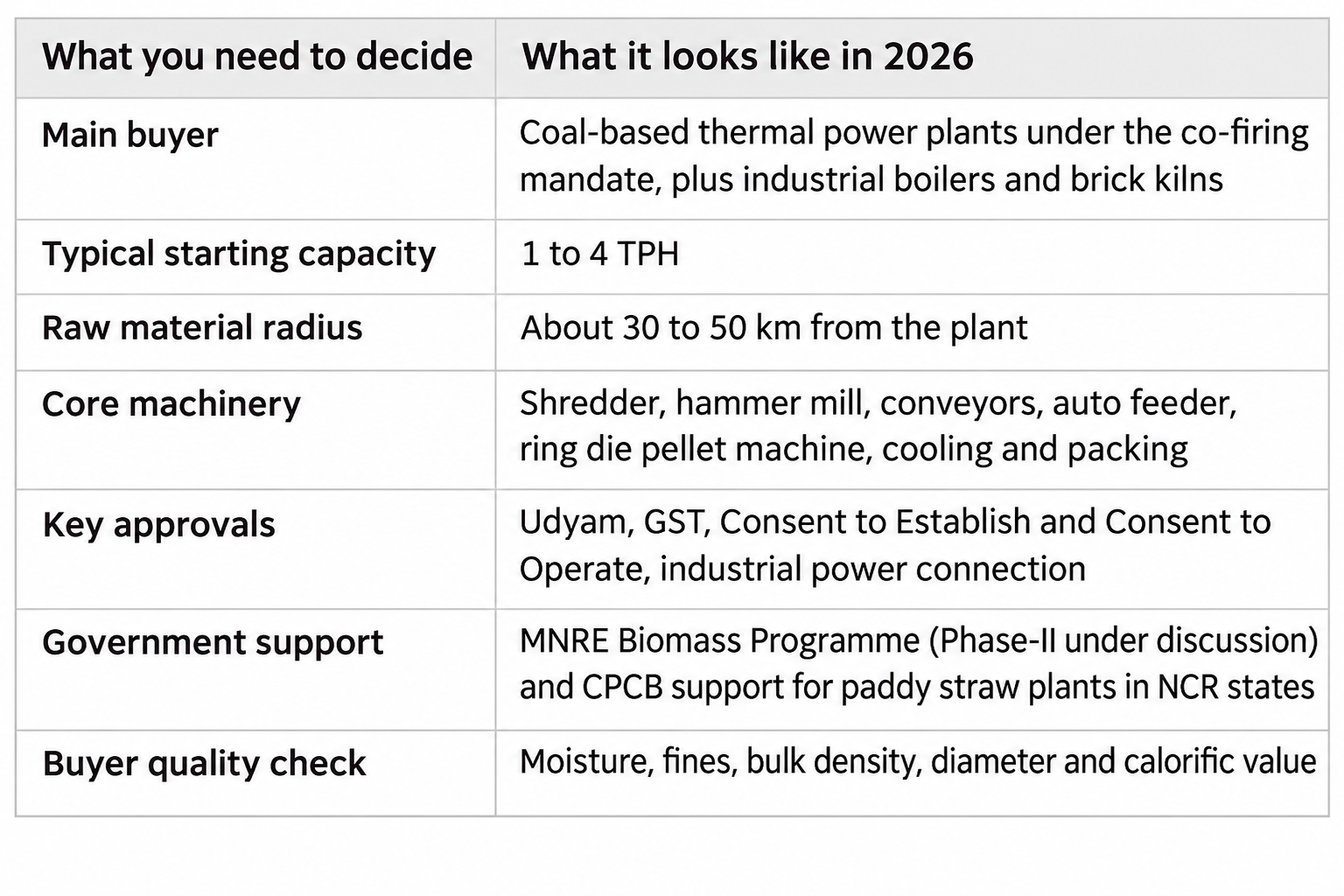
Biomass Pellet Plant Setup in India at a Glance
Why Start a Biomass Pellet Plant in India in 2026
A government mandate has created guaranteed buyers. On 7 November 2025 the Ministry of Power issued a comprehensive co-firing policy, and Down To Earth reports that Delhi-NCR plants must use a 5 per cent blend of biomass pellets by weight plus an additional 2 per cent blend, while plants outside NCR must co-fire 5 per cent from FY 2025-26. India runs a very large coal fleet, so even a 5 per cent share means millions of tonnes of pellets every year.
Regulators now enforce this rule with real penalties. In April 2026 the Commission for Air Quality Management imposed environmental compensation of about Rs 61.85 crore on six thermal power plants within 300 km of Delhi for missing their co-firing norms in 2024-25. Meanwhile NCR thermal plants had used 4.38 million tonnes of pellets by 15 June 2026, and industry experts still flag inconsistent pellet quality as a problem. A power plant facing penalties has every reason to sign reliable suppliers on long contracts.
Raw material is rarely the bottleneck. The National Biomass Atlas prepared under MNRE estimates that India generates about 228.5 million tonnes of surplus biomass residue every year. Paddy straw, mustard husk, cotton stalk, wheat straw, groundnut shell and sawdust all work as feedstock. What the market lacks is processing capacity that turns loose residue into dense and transportable fuel, and that is the gap a well-planned pellet plant fills for farmers, mill owners and first-time entrepreneurs alike.
Step 1: Find Your Pellet Buyer First
Most first-time investors start by asking for a machine quotation, but the right starting point is the buyer. Your buyer decides the pellet diameter, raw material mix, calorific value, packing and transport. NTPC’s June 2026 tenders for stations such as Lara, Korba, Mouda and Sipat ask for non-torrefied agro-residue pellets with a gross calorific value of 2,800 to 4,000 kcal/kg over a two-year delivery period. A nearby boiler owner may accept a different size and moisture level, so fix your buyer before you fix your machines.
Study live tenders on the Government e-Marketplace (GeM) and notices on the SAMARTH mission portal of the Ministry of Power. Recent NTPC tenders allow part-quantity bidding, give purchase preference to MSEs and accept “future pellet manufacturers” with a certified project plan. A plant still under construction can therefore bid and use the order to support its bank loan. Keep a second channel open with local boilers or brick kilns so that one delayed payment cycle does not stall your cash flow.
Step 2: Choose the Right Pellet Plant Capacity
Capacity drives your machinery size, connected load, shed area, manpower and working capital. Most new plants in India start between 1 and 4 tonnes per hour (TPH), which matches the indicative output range of TRIO’s vertical ring die pellet machines. A 1 TPH plant suits a first project with limited residue, while 2 to 4 TPH makes sense when you have assured supply and a firm buyer. Subsidy schemes also calculate support per TPH, so capacity shapes the grant you can claim.
Do not size the plant on the best-case raw material. A machine rated on soft and dry straw produces less on hard stalks or damp residue because it needs more energy to press tougher material. Plan for realistic running hours, a weekly maintenance stop and seasonal gaps in supply. Our guide on biomass pellet plant cost in India breaks down machinery, shed, power and working capital for 1 to 5 TPH plants and is the best next read once you have a capacity in mind.
Step 3: Secure Raw Material for Year-Round Production
Raw material makes or breaks a pellet plant, and logistics decide its cost more than the residue itself. Loose straw has very low bulk density, so transport eats into margins as distance grows. Outlook Business notes that crop residue usually stays economically viable only within a radius of 30 to 50 km. Map the villages, mills and farms inside that radius and estimate how much residue each season leaves after fodder and household use. This local survey gives you a far more honest picture than state-level figures.
Most residue becomes available in a short window after harvest while your plant runs all year, so you need storage space, baling arrangements and agreements with farmers or aggregators. Mixing two or three residues often improves pellet quality and keeps the plant running when one crop is out of season. The calendar below helps you plan. Harvest timing shifts by a few weeks between states and years, so confirm it with farmers and mills in your own area.
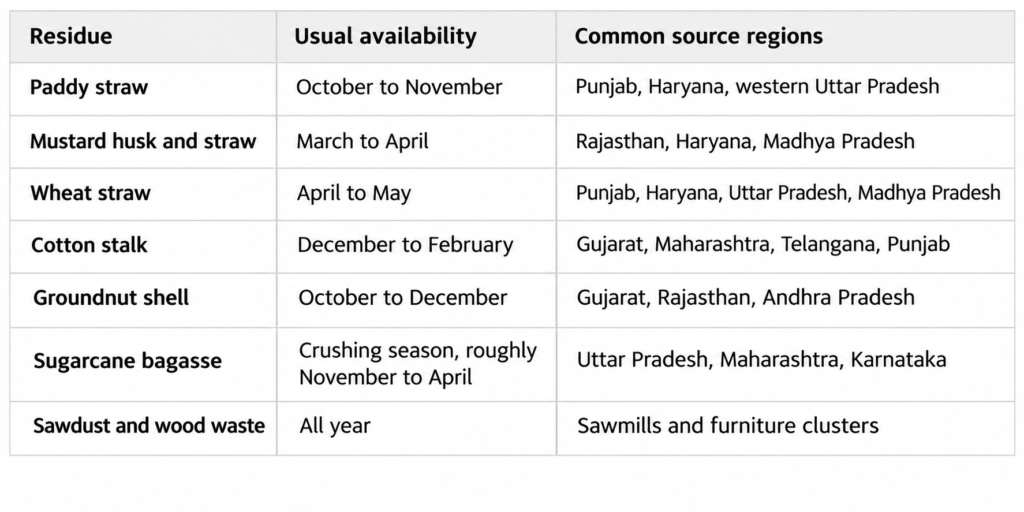
Raw material calendar for pellet plants
Moisture affects pellet quality more than any other variable. Material that is too wet produces soft pellets that crumble in transport, while material that is too dry wears the die and rollers faster and cuts output. Fresh straw usually carries more moisture than the pelletising stage accepts, so plants dry it in the open yard or add a dryer to the line. Keep a moisture meter at the feeding point and train operators to check it every shift, because this one habit prevents most buyer complaints.
Step 4: Plan Land, Shed and Power Connection
Choose land with good road access for trucks and tractors, a reliable power supply and plenty of open space for raw material storage. The storage yard is usually much larger than the shed because loose and baled residue takes up a lot of room. Keep the site away from dense housing since shredding and grinding create dust and noise, and check your state’s land use rules before you buy or lease. A site close to your residue villages and within reasonable distance of your buyer saves money at both ends.
The pellet machine and size reduction machines draw significant power, so apply for an industrial connection early. TRIO’s ring die pellet machines come in 90, 132, 160 and 250 kW variants depending on the model, and the shredder, hammer mill and conveyors add to that load. Plan a covered shed with enough height for the cyclone and elevators, a dry finished-goods store and a small workshop for die and roller work. Our pellet plant installation and commissioning team can share a recommended layout so that civil work and machine foundations match from day one.
Step 5: Select the Complete Biomass Pellet Plant Machinery
A pellet plant works as one connected line, and the weakest machine sets the output of the whole plant. Many buyers focus only on the pellet machine and later struggle because the shredder or hammer mill cannot feed it fast enough. The right approach matches every machine to the same hourly capacity and the same raw material. The sections below follow the material from the yard to the finished pellet, and you can see every machine on our complete biomass pellet plant machinery page.
Biomass shredder machine
The shredder breaks bales and long stalks into short pieces that the next machine can handle. Paddy straw and cotton stalk arrive as tangled and fibrous masses, and feeding them straight into a hammer mill overloads the mill and wastes power. A twin-shaft biomass shredder cuts and tears this material into uniform chips at a steady rate, which protects every machine downstream.
Industrial hammer mill
The hammer mill grinds shredded material into fine and even particles. Particle size directly affects pellet density and durability, because the pellet machine binds small particles far better than coarse ones. The screen inside the mill controls this size, and operators change screens to suit each raw material. A cyclone after the mill separates the ground material from air and keeps the shed cleaner.
Conveyors, elevators and auto feeding unit
Conveyors, screw conveyors and Z-type elevators move material between machines without manual handling. They save labour, reduce dust and keep a constant flow, which is the secret of stable output. The auto feeding unit meters ground material into the pellet machine at a controlled rate. Uneven feeding chokes the die or runs it empty, so a reliable feeder pays for itself through fewer stoppages and longer die life.
Vertical ring die pellet machine
The pellet machine presses ground biomass through holes in a hardened ring die using heavy rollers, and the heat from friction softens the natural lignin that binds the particles into firm pellets. TRIO manufactures a vertical ring die pellet machine range that includes the TRIO560 in 90, 132 and 160 kW variants, the TRIO700 at 160 kW and the TRIO850 at 250 kW. These machines give an indicative output of 1 to 4 TPH and pellet sizes from 6 to 16 mm. In a vertical design gravity feeds material straight into the die, which suits light and fibrous agro residue.
Cooling, screening and packing
Pellets leave the die hot and slightly soft. Cooling hardens the surface and lowers moisture, which reduces breakage during transport. Screening removes fines that you can send back into the line, and you then pack in bags or load in bulk as your buyer specifies. The full flow runs from shredder to hammer mill, conveyor, auto feeder, pellet machine, cooler and packing, and our step-by-step pellet plant process page shows each stage with photos.
Step 6: Take the Right Licences and Approvals
A pellet plant needs the same registrations as any small factory along with pollution control consent. The SAMARTH mission publishes a list of clearances for a biomass pellet manufacturing unit that covers company registration, Consent to Establish (CTE) and Consent to Operate (CTO) from the State Pollution Control Board, water or borewell permission and labour registrations. Register on the Udyam portal early, because MSME status gives you purchase preference in government tenders. Pollution category and consent fees vary by state, so confirm the current rules with your State Pollution Control Board before you file.
- Company, LLP or proprietorship registration
- Udyam (MSME) and GST registration
- Land documents, change of land use where required and building plan approval
- CTE before construction and CTO before production
- Industrial electricity connection and water permission
- Factory, labour and fire safety compliance as applicable
Step 7: Apply for Biomass Pellet Plant Subsidy
Government support can reduce your machinery burden considerably, but each scheme has strict timing and eligibility rules. Two central routes matter most for pellet plants, and many states add their own incentives on top. Read the rules before you order machinery, because some schemes reject applications filed after commissioning.
MNRE Biomass Programme
After a July 2024 revision, MNRE set central financial assistance for non-torrefied pellet plants at Rs 21 lakh per MTPH, up to Rs 105 lakh per project, and for torrefied plants at Rs 42 lakh per MTPH, up to Rs 210 lakh, or 30 per cent of plant and machinery cost for a 1 MTPH plant, whichever is lower. Applications go through the BioURJA portal before commissioning. Phase-I covered FY 2021-22 to FY 2025-26, and in August 2026 Bioenergy Times reported that MNRE was seeking funds for Phase-II, so check the MNRE biomass page for the current position.
CPCB support for paddy straw pellet plants
The Central Pollution Control Board offers one-time support for new plants that use paddy straw from Delhi, Punjab, Haryana and the NCR districts of Rajasthan and Uttar Pradesh, as the PIB release explains. After the March 2023 revision, Down To Earth reports that support for non-torrefied plants rose to Rs 28 lakh per TPH. The SAMARTH guideline note allows other biomass only as a binder up to 20 per cent of the paddy straw used. Plants in these regions may choose either MNRE or CPCB support, whichever suits them better.
State incentives
Several states run their own schemes. Rajasthan notified the Rajasthan Biomass and Waste to Energy Policy, 2023 to promote pellet plants and co-firing, and Punjab has mandated straw pellet use in brick kilns to build local demand. Check your state’s industrial and MSME policies for electricity duty exemption, stamp duty relief or interest subsidy, which often stack with central support.
Step 8: Prepare Your Project Report and Arrange Finance
A detailed project report (DPR) turns your plan into numbers that a bank or subsidy agency can judge. It should cover capacity, raw material sources and price, machinery quotations, land and civil cost, power load, manpower, working capital, selling price and your planned buyer. Base the selling price on actual tender rates and local enquiries rather than hopeful guesses. Working capital needs special care because you buy most residue right after harvest but sell pellets over the following months, and power plant payments follow delivery and quality testing. The biomass pellet plant cost in India guide helps you build the cost side.
Collateral-free loans under CGTMSE
The Credit Guarantee Fund Trust for Micro and Small Enterprises (CGTMSE) lets banks lend to micro and small enterprises without collateral or third-party guarantees, with guarantee cover for loans up to Rs 10 crore according to Bajaj Finserv’s scheme summary. The Reserve Bank of India also doubled the mandatory collateral-free lending limit for these enterprises to Rs 20 lakh from 1 April 2026, as IIFL Finance explains. Ask your bank which route fits your loan size.
GST on biomass pellets
Under the GST schedule in force from 22 September 2025, wood waste agglomerated into pellets falls under heading 4401 at 5 per cent, as TaxClue’s HSN 4401 page shows. Agro residue pellets may fall under a different sub-heading, so confirm the HSN code and rate with your chartered accountant before your first invoice.
How to calculate profit and payback
You can test your plant’s viability with three numbers per tonne: selling price at the buyer’s gate, raw material cost including transport and operating cost for power, labour, wear parts and overheads.
Margin per tonne = Selling price − (Raw material + Transport + Power + Labour + Wear parts + Overheads)
Annual surplus = Margin per tonne × Realistic annual output
Simple payback (years) = (Project cost − Subsidy) ÷ (Annual surplus − Loan interest)
Run the numbers three times: with expected figures, with raw material 15 to 20 per cent dearer and with output 20 per cent lower. If the plant still pays back in a period your bank accepts under the weaker cases, your plan holds. If it works only in the best case, revisit capacity, location or buyer before you spend on machinery.
Step 9: Install, Commission and Train Your Team
Installation begins once the shed, foundations and power connection are ready. Machines go onto their foundations in line order, followed by conveyors, ducting, cyclones and the electrical panel. A careful supplier aligns every drive and runs each machine empty before any material goes in. Trial runs then use your actual local residue, and you should expect to adjust moisture, screen size and feeding rate until the pellets come out firm and consistent. Use this period to train operators on start-up order, motor load readings and safe clearing of a choked die, and keep production and power records from the first week if you plan to claim MNRE support.
Step 10: Maintain the Plant and Protect the Ring Die
The ring die and roller shells are wear parts, and their life depends on clean raw material, correct moisture, steady feeding and timely lubrication. Sand, stones and metal in the residue damage the die quickly, so clean your feedstock and fit magnets where tramp metal is a risk. Keep a spare ring die, roller shells, roller bearings, roller shafts and cutting knife holders in stock so you can swap parts in hours instead of losing days. TRIO supplies pellet machine spare parts for its machines, and a short weekly maintenance stop with a log of every part change helps you predict the next one.
Fire and dust safety
Dry biomass burns easily, and a pellet plant stores hundreds of tonnes of it. Stack raw material in separate blocks with fire lanes between them, ban smoking and open flames across the yard and keep extinguishers and hydrants within reach. Inside the shed, clean hammer mill dust from beams, motors and panels every shift and check bearing temperatures daily, because a hot bearing near settled dust can start a fire.
Step 11: Meet Pellet Quality Standards and Sell Your Output
Power plant buyers judge pellets on moisture, fines, density, size and calorific value, and they test each consignment at the receiving end. The SAMARTH mission publishes a model technical specification for agro residue pellets that tenders build on. Always read the specification attached to your own tender, since each buyer can adjust it for its boilers.
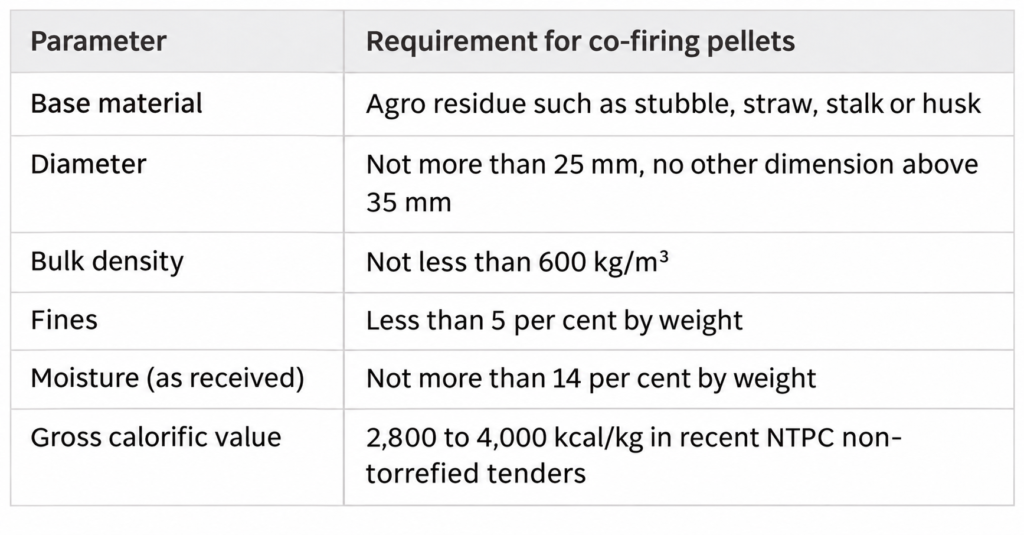
Straw-based pellets carry high ash, and a SAMARTH operating guideline lists typical non-torrefied pellet ash at roughly 20 per cent with a GCV of 3,400 to 4,000 kcal/kg. Many websites quote an “IS 17225-6:2016” for Indian pellets, but 17225-6 is the international standard ISO 17225-6. BIS has instead circulated a draft Indian Standard for pellets from agro and herbaceous residues based on it, and has published test methods such as IS 17642 for bulk density, listed on the SAMARTH portal. Test your trial pellets in a fuel laboratory before you sign any supply contract.
Once the plant runs steadily, spread your sales. Power plant contracts give volume and stability, while local boilers, dryers and kilns often pay faster and take smaller lots. Some producers later move to torrefied pellets, which the SAMARTH mission director told ANI were selling at Rs 28,000 to Rs 35,000 per tonne in 2025, although they need extra equipment and higher investment.
Common Mistakes in a Pellet Plant Project
The costliest mistake is buying machines before securing raw material and a buyer, which leaves a new plant idle in its first season. Close behind come a pellet machine bought without matching shredder and hammer mill capacity, poor moisture control blamed on the machine, too little storage space and thin working capital. Some owners also build the shed before the supplier shares a layout and then pay for civil changes. Finally, avoid choosing a supplier only on price. Visit running plants, speak to their owners and ask how quickly the supplier responds to a breakdown, because downtime and spare parts decide your real cost over the years.
Is a Biomass Pellet Plant Right for You?
If you can tick most of these boxes, you are ready for a project report and a machinery discussion.
- I can source at least two types of residue within about 50 km of my site.
- I have spoken to a buyer and understand its specification and payment terms.
- I have land with road access, storage space and a power connection in sight.
- I can fund working capital for the post-harvest buying window.
- I or a trusted manager can be at the plant daily during the first season.
- My machinery supplier will install the line, train my team and supply spare parts.
How TRIO Renewable Engineering Supports Your Pellet Plant Setup
TRIO Renewable Engineering manufactures biomass pellet plant machinery in Jaipur and sets up plants for clients across India. Our range covers twin-shaft biomass shredders, hammer mills, auto feeding units, conveyors, Z-elevators, round bale trolleys and the TRIO vertical ring die pellet machine series along with their wear parts. Because we build the complete line, we match every machine to your raw material and target capacity. Our team helps you plan capacity and layout, supplies the machinery, carries out installation and commissioning and supports you with spare parts after start-up.
Ready to plan your biomass pellet plant? Call or WhatsApp +91 85059 02337 or +91 92515 94751, or talk to our plant team for a project discussion and quotation.
Frequently Asked Questions
Find a buyer and a reliable raw material source within about 30 to 50 km, choose a capacity and prepare a project report. Then take MSME, GST and pollution control consents, arrange finance and order a matched machinery line. After trial runs, test your pellets against the buyer’s specification before regular supply.
Paddy straw, wheat straw, mustard husk, cotton stalk, groundnut shell, soya husk, bagasse and sawdust are common in India. Blends often give better pellets than a single residue, so test your local material during trials.
Most new plants fall between 1 and 4 TPH. TRIO’s TRIO560, TRIO700 and TRIO850 ring die pellet machines cover an indicative 1 to 4 TPH range.
MNRE has supported non-torrefied pellet plants at Rs 21 lakh per MTPH, up to Rs 105 lakh, under Phase-I of the National Bioenergy Programme, and CPCB supports paddy straw plants in NCR states. Phase-II was under discussion in 2026, so check the BioURJA portal before you apply.
Coal power plants are the largest buyers because of the co-firing mandate, and NTPC buys through GeM tenders. Industrial boilers, dryers and brick kilns also buy pellets, often in smaller lots.
Power plant tenders judge pellets on their own specification and lab tests rather than a BIS mark. BIS has a draft standard for agro residue pellets and published test methods, so check its current status before planning certification.
Wood-based pellets fall under heading 4401 at 5 per cent from 22 September 2025. Agro residue pellets may fall under a different sub-heading, so confirm with your chartered accountant.