
TRIO 100×160
200kW
- Speed
- 2880 RPM
- Output*
- 6 – 7 TPH
- Dust collector
- Pulse Jet
Built for performance. Made to last. Grinds straw, husk, stalks and wood into fine, even powder, ready for your pellet mill.
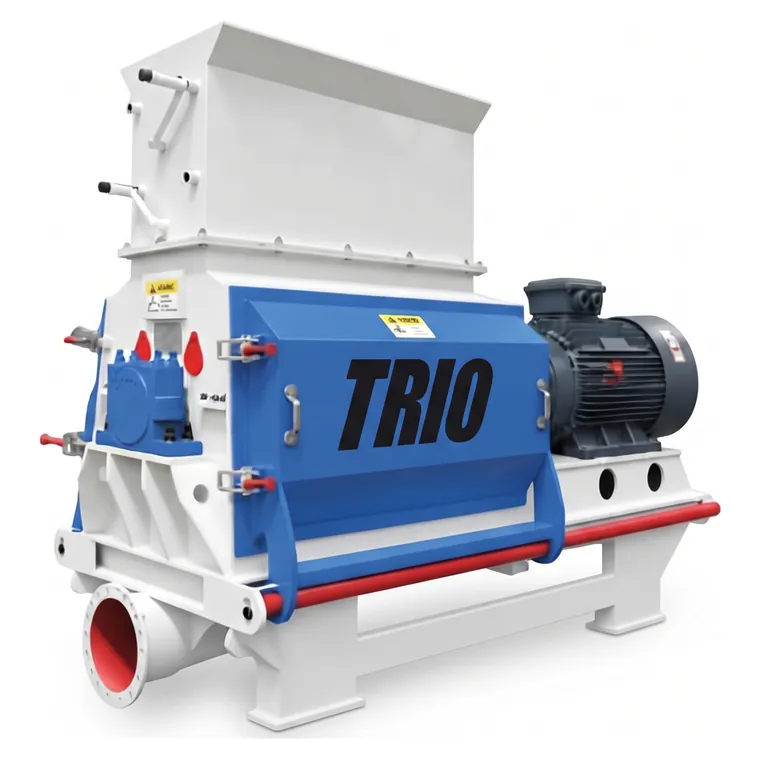
A pellet is only as good as the powder that goes into it. The TRIO hammer mill takes shredded straw, husk, stalks or wood and grinds it into fine, even powder that the ring die can press into strong, uniform pellets.
Fast-swinging hammers break the material against the chamber wall, and a sizing screen lets only the right-sized particles out. It runs cool under load and is built for long hours in heavy-duty biomass work.
IMP series runs at 2880 RPM with a Pulse Jet dust collector. IND series runs at 1440 RPM without Pulse Jet.
* Machine output depends on material type, moisture content and material density. Figures are indicative only.
Matched to your hammer mill's motor power. The magnet slab keeps iron out of the mill, the input conveyor and auto feeder keep the feed steady.
700 × 700 × 200 mm
For 75 / 90 kW hammer mill
900 × 900 × 200 mm
For 160 / 200 kW hammer mill
0.8 m × 8 m · V type
For 75 / 90 kW hammer mill
1 m × 8 m · V type
For 160 / 200 kW hammer mill
20 ft
For 75 / 90 / 160 kW hammer mill
30 ft
For 160 / 200 kW hammer mill
Rule of thumb: the hammer mill should grind a little more than the pellet mill presses, so the pellet mill never waits for powder.
Typical pairing based on TRIO capacity figures. Hard or wet materials may need the next size up; our engineers confirm the match for your raw material.
The screen decides the particle size. Material keeps grinding until it is small enough to pass through.
Shredded straw, husk or sawdust enters the grinding chamber at a steady rate from the conveyor.
Hammers on a fast rotor strike the material and throw it against the chamber wall, breaking it down.
Only particles small enough to pass the sizing screen leave the chamber; the rest keep grinding.
Fine, uniform powder goes on to the conveyor or Z-elevator and the pellet mill feeder.
The hammer mill gives the pellet mill the fine, even powder it needs. Its screen size sets the particle size.
Swinging hammers and a sizing screen turn shredded residue into even powder that presses into consistent pellets.
Designed to run cool under load, so the material keeps its quality and the machine keeps running.
A rigid frame, quick-open doors and a direct-coupled motor give long service life in tough biomass work.
Grinds straw, husk, stalks, sawdust and wood chips after shredding, ready for the pellet mill.
Shred first, then grind. High silica wears hammers faster, so check them often.
Grinds easily after shredding into a light, fine powder.
Can often be ground directly, without a shredder.
Shells grind straight into pellet-ready powder.
Already fine: a quick pass evens out the particle size.
Chips from a sawdust making machine are ground down for pelletizing.
Moisture matters. Dry material grinds faster and uses less power. Very wet feed can clog the screen: bring it to about 10–15% moisture for the best result.
Most hammer mill issues come down to wear, the screen or the feed.
Likely causeWorn hammers, a blocked screen or wet material.
FixTurn or replace hammers, clean the screen, dry the feed to 10–15% moisture.
Likely causeTorn or worn screen, or a screen with holes that are too big.
FixCheck the screen for tears and fit the right hole size for your pellet line.
Likely causeHammers worn unevenly or replaced one at a time, so the rotor is out of balance.
FixReplace hammers in full sets and check bearings.
Likely causeFeeding too fast, or the feed comes in surges.
FixUse a steady feed from the conveyor or auto feeding unit.
Likely causeMaterial stays in the chamber too long because the screen is clogged.
FixClean the screen, check moisture and keep the discharge clear.
Likely causeStones or metal in the feed.
FixStop the mill, remove the object, and use stone separation and a magnet before the mill.
Not answered here? Ask our team on WhatsApp or call us.
It grinds shredded straw, husk, stalks or wood into fine, even powder. Even particle size is what lets the pellet mill make strong, consistent pellets and keeps die wear and power use down.
Choose a hammer mill that can grind a little more than your pellet mill can press, so the pellet mill never waits for material. The pairing table on this page shows the usual match for each TRIO pellet machine; our engineers confirm it for your raw material.
For straw bales and long stalks, yes. Mustard husk, groundnut shell, sawdust and wood chips can usually go straight into the hammer mill.
It depends on your pellet size and raw material. Smaller pellets need finer powder. We fit the right screen when we size your plant.
The most common causes are worn hammers, a blocked or torn screen and wet material. See the troubleshooting table on this page.
It depends on how abrasive the material is and how many hours the mill runs. Silica-rich paddy straw wears hammers fastest. Turn hammers to use all their edges, and replace them in full sets to keep the rotor balanced.
Yes. The same mill can grind straw, husk, stalks and wood. Output changes with each material, so size the mill for the hardest material you plan to use.
Yes. TRIO supplies hammers, screens, bearings and other wear parts for its hammer mills.
It depends on the model and your plant line. Share your raw material and target output and we will send an exact quote.
Share your model, raw material and location. Our team replies with the right configuration and price.
Talk to a TRIO engineer about your raw material, capacity and budget.